Table of Contents
The most important people in this chapter
Click here.
Djiguite (or Jigit)
Djiguite, also spelt as jigit, yigit, zhigit or igid, is a word of Turkic origin that is used in the Caucasus and Central Asia to describe a skilful and brave equestrian or a brave person in general.

Click here for more information.
Rostov-On-Don
Rostov-on-Don is a port city. It lies in the southeastern part of the East European Plain on the Don River, 32 kilometres (20 mi) from the Sea of Azov, north of the North Caucasus.

The Armenian Monastery


The Kalmyks
The Kalmyks are a Mongol subgroup in Russia, whose ancestors migrated from Dzungaria in 1607. They created the Kalmyk Khanate in 1630–1771 in Russia’s North Caucasus territory. They are traditionally Buddhist.
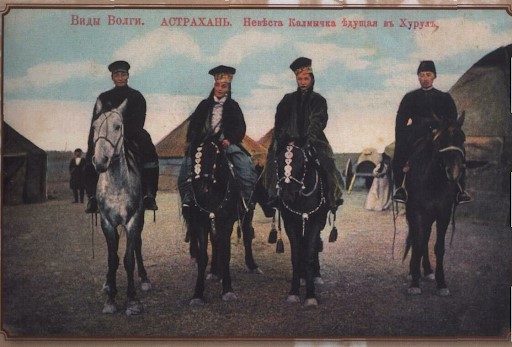
Click here for more information.
I have to say I looked rather pale.
“The soldiers marched us down the stairs of the hotel, and there was this large mirror in the lobby, so I saw myself coming down the stairs…” He coughed nervously. “I have to say I looked rather pale.”And Sergey smiled a trembling smile.
Chapter 15
Sergey’s memories were shared with me by Marina (Maria’s daughter), including details like the mirror and ‘looking rather pale’.
Novorossisk
Novorossisk is a city in Krasnodar Krai, Russia. It is the country’s main port on the Black Sea
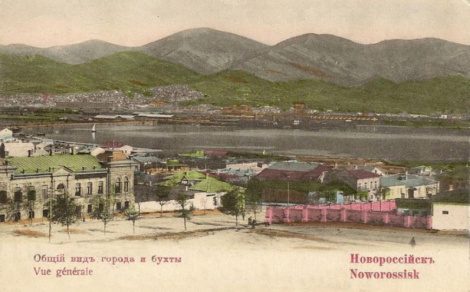
When Alexandra was there, the town was heaving with an estimated 500.000 unregistered refugees, according to Laurie Kopisto in his dissertation (Kopisto, p.168)
Further References about the Novorossisk Rescue / Catastrophe :
- Ash, L., (2017), Death Island: Britain’s Concentration Camp in Russia, October 19th on the BBC, [online], available at http://www.bbc.com/news/magazine-41271418 [accessed 30/12/2017].
- Aten, M., Orrmont, A., (2011), Last Train Over Rostov Bridge, revised ed., London: Thin Red Line Publishing.
- Hughes, J., K., (2005), The Unwanted: Great War Letters from the Field, Alberta: University of Alberta.
- Kinvig, C., (2006), Churchill’s Crusade: The British Invasion of Russia, London: Bloomsbury Publishing.
- Kopisto, L. (2011), British Intervention in the Russian Civil War, Helsinki: Helsinki University, [online], available at https://helda.helsinki.fi/bitstream/handle/10138/26041/thebriti.pdf [accessed 30/12/2017].
- Lincoln, W. B., (1989), Red Victory: A History of the Russian Civil War, New York: Simon & Schuster.
- Melgunoff, S., (1927), Record of the Red Terror, [online], available at http://www.paulbogdanor.com/left/soviet/redterror.pdf [accessed 30/12/2017].
- Occleshaw, M., (2006), Dances in Deep Shadows: Britain’s Clandestine War in Russia 1917-1920, London: Constable & Robinson.
- Smith, J., T., (2010), Gone to Russia to Fight: The RAF in South Russia 1918-1920, London: Amberley Publishing.
- Williamson, H.N.H., (1971), Farewell to the Don, ed. Harris, J., New York: The John Day Company.
- Wright, D., (2017), Churchill’s Secret War: British & Commonwealth Intervention in South Russia 1918-1920, Solihull: Helion Publishing.
- https://southrussiadiary.wordpress.com/2018/01/07/rostov/
Thanks
Special gratitude to Marina Gewlitch Chatsky – Maria Kamendrovsky’s daughter – for sharing her family memories and her mother’s story in her small apartment in Queens, New York, some twenty years ago (see sources for her story)