Table of Contents
The Kamendrovsky Family
Click here.
The most important people in Tiflis
Click here.
Old Pictures of Georgia
Click here
The Shatiloff House
The Shatiloff house was on 8 Baryatinskaya Street, on the descent from Golovinsky Prospekt to Kura. Before, it had belonged to Prince Andrey Ivanovich Baryatinsky.
Madam Bozarjants House

The house my family stayed in is nowadays known as ‘The House of Madam Bozarjants’. This is because Nikogos Sr. was a prudent businessman who wanted to ensure himself against encroachments on private property. He designed the mansion for his wife, Ekaterina Grigorevna Bozarjants. To protect from deprivation, the Millionaire had his house put in his wife’s name.
The Tabocco Kings of Tiflis

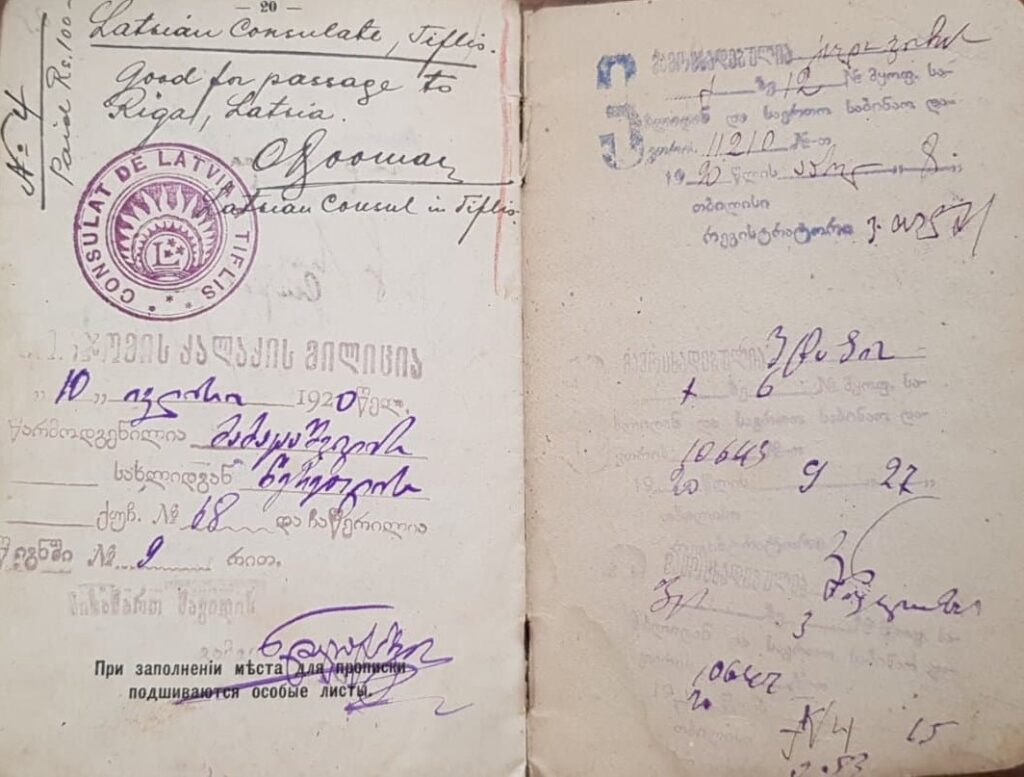
The Bozarjants’ address in the Kamendrovsky passport

The house of Alexander Melik-Azaryants

Alexander Melik-Azaryants built a tenement house in honour of the memory of his untimely deceased daughter, Takuy. At the beginning of the twentieth century, it had its own electricity and water supply, heating system, telephone network, kindergarten, cinema, photo studio, art gallery and a garden with a fountain and exotic plants.
Ja-Da
“Ja-Da (Ja Da, Ja Da, Jing, Jing, Jing!)” is a hit song written in 1918 by Bob Carleton. The title is sometimes rendered simply as “Jada.”
Artists in Tiflis
Tiflis had a vibrant artistic life in the years of the revolution. A large group of creative literary-artistic intelligentsia was at once closely connected with national Georgian life and nurtured by the best traditions of European and Russian culture. Tiflis attracted many poets and avant-garde artists from Moscow and St. Petersburg; they came first out of curiosity, having heard about a unique artistic “paradise” in Tiflis, and later to get away from the troubled years of war and revolution.
Painters of Kimerioni:
Lado Gudiashvili

(30 March 1896 – 20 July 1980)
A prominent Georgian painter, graphic artist and muralist, teacher and professor. Gudiashvili studied extensively, and by the end of the 1910s, he had become a renowned professional painter whose works were widely exhibited in Tiflis.
At the end of 1919, the Society of Georgian Painters sent Gudiashvili to study in Paris; the society also sent to France his older colleague and friend David Kakabadze (1889-1952), who later became a founder of cubism in Georgian art.
Davit’ Kakabadze

(20 August 1889 – 10 May 1952)
A leading Georgian avant-garde painter, graphic artist and scenic designer. A multi-talent, he was also an art scholar and innovator in the field of cinematography, as well as an amateur photographer. Kakabadze’s works are notable for combining innovative interpretations of European “Leftist” art with Georgian national traditions, on which he was an expert.
After a brief period of working as a painter and educator in Tbilisi, he went to Paris, where he lived from 1919 to 1927. In 1923, he constructed a film camera that produced the illusion of relief and thus became one of the pioneers of three-dimensional cinema.
Kakabadze became a professor at the Tbilisi State Academy of Arts in 1928 but came under pressure from Soviet authorities for “failure” to abandon Formalism and adapt to the dogmas of Social realism. Eventually, he was dismissed from the Academy in 1948.
Sergey Yurievich Sudeikin
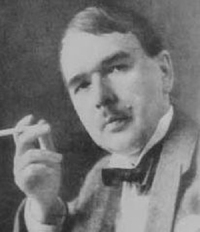
(19 March 1882 – 12 August 1946 in Nyack, New York)
A Russian artist and set-designer associated with the Ballets Russes and the Metropolitan Opera. He was one of the most famous Russian designers of his time.
Paolo Iashvili
Poet who declared Tbilisi, not Paris, Centre of World Culture

(29 June 1894 – 22 July 1937)
A Georgian poet and one of the leaders of the Georgian symbolist movement.
Under the Soviet Union, his obligatory conformism and the loss of his friends at the height of Stalin’s Great Purge heavily affected Iashvili, who committed suicide at the Writers’ Union of Georgia.
Mravalzhamieri
This is a Georgian folk song, the title and the one-word text of which can be translated as “[may you live] a long life”. It is a popular and widespread toasting song, with dozens of different versions from the countryside of both eastern and western parts of Georgia.
Thanks
With special thanks to David Nozadze for translating, helping me find information and websites and for his support. დიდი მადლობა დევიდ