Table of Contents
The Bozarjants
Nikogos Bozarjants

Nikogos Hovhannes Bozarjants was a Western Armenian who founded a big Tobacco factory called Sympathy in 1858 in Tbilisi, bringing high-quality raw materials from Turkey and selling high-quality cigarettes. He was an official supplier of the Grand Duke Nikolai Mikhailovich
In 1889, at the Caucasian exhibition of agricultural and industrial products, he was awarded a gold medal for excellent ground tobacco and cigarettes. He became the real leader of the tobacco industry in the whole Caucasus.

This was successfully continued by his sons Hovhannes and Arshak, who founded the company “N.O.Bozarjants and sons.” Nikogos and his wife, Ekaterina Grigoryevna, had three sons – Hovhannes, Mikhail and Arshak. They were the first in Tbilisi to own a car, which was from Paris, with a driver.
For one whole year, the Kamendrovskys enjoyed the hospitality of their grandson, who was also called Nikogos, the son of Mikhail, in their beautiful house on 12 Gudovich Street (nowadays Chonkadze Street), which was built from 1912 to 1914. In 1915, this house received a special architectural award in a competition organised by the City Hall for the best facade. Rumour says that when laying the house, the richest people of the city threw jewellery from the chaise into the concrete foundation – for good luck.
But they did not bring luck. In 1921, the Bozarjants and Sons enterprise was nationalised, and their cigarettes, which were called Sympathy, were now sold as Prima tobacco. Thanks to the equipment the Bozarjants installed, the Soviets could keep selling their high-quality cigarettes.
The party elite moved into the house. They allowed Nikogos jr. and his mother, Varvara, to occupy one room in their house, on the third floor at the very end of the corridor.
One of the new inhabitants of the house was the Bolshevik Aleksandr Gegechkori, who was given all the expensive furniture of the Bozarjants; their piano, their mother-of-pearl inlaid screen, all the treasures of the Persian room and much more. Every Thursday, people gathered at Gegechkori’s to play lotto, and Mother Varvara did not miss a single game, because that was an occasion to sit on furniture that once belonged to the family. His name is still engraved on a plate next to the door.
Nikogos, with all his outstanding education, worked as a taxi driver. He often drove the children of the neighbourhood around in his taxi. They did manage to hide a lot of their jewellery, and when things were tight, Varvara sold yet another piece. Nikogos did not make a lot of money, but he did keep up one family tradition. They kept having dinner in a restaurant once a week.
Click here for more information.
Nikolai Shatiloff
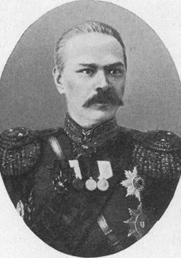
( 1849 – 1919 )
Father of General Pavel Shatiloff. He was a general from the infantry of the Russian imperial army, a member of the Council of State.
In 1917, he retired and left for Tiflis, where he had a huge house at the address 8. Baryatinskaya Street. It was located on the descent from Golovinsky Prospekt (now Rustaveli Avenue ) to Kura. Before Shatilov, it belonged to Prince Andrei Ivanovich Baryatinsky. Nikolai died in the spring of 1919.
Alexander Melik-Azaryants
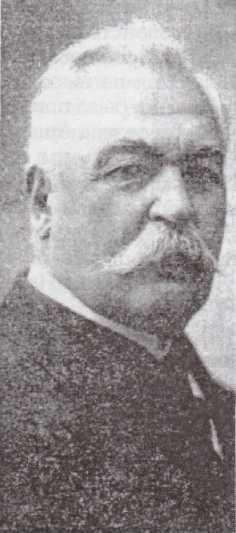
(1847 – 1923)
Alexander Melik-Azaryants was a merchant of the First Guild and the owner of oil fields. Alexander Melik-Azaryants lived in this city and was known as a man not only wealthy but also generous. He was a member of the board of the charity, and did not spare money for the construction of hospitals, schools and churches.
He built a tenement house in honour of the memory of his untimely deceased daughter, Takuy. At the beginning of the twentieth century, it had its own electricity and water supply, heating system, telephone network, kindergarten, cinema, photo studio, art gallery and a garden with a fountain and exotic plants.

As for the fate of Alexander Melik-Azaryants, unlike other millionaires who managed to emigrate, he remained in Tiflis. His house was nationalised, and he was allocated a room under the stairs in the entrance of his own house. He died in poverty and was buried with his friends’ money.
Giorgi Svanidze
Georgian classmate of brother Feodor, first love of Lydia.
Mystic George – George Ivanovich Gurdjieff
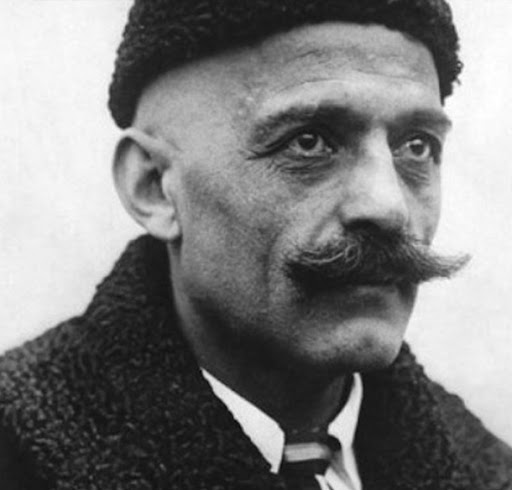
(14 January 1872– 29 October 1949)
George was a mystic, philosopher, spiritual teacher, and composer of Armenian and Greek descent. Gurdjieff taught that most humans live their lives in a state of hypnotic “waking sleep”, but that it is possible to awaken to a higher state of consciousness and achieve full human potential.
During the Revolution, he set up a temporary study community in Yessentuki from spring 1917 until early August 1918. He then moved on to Maykop, Sochi and Poti, before moving to Tbilisi. In late May 1920, political conditions in Georgia had changed, and the old order was crumbling. Just like the Kamendrovskys, he travelled to Batumi on the Black Sea coast and travelled by ship to Istanbul, where they stayed for some time. In 1936, he settled in Paris, where he was to stay for the rest of his life.
Thomas Alexandrovich de Hartmann

(21 September 1885 – 28 March 1956)
A Russian composer and prominent student and collaborator of George Gurdjieff. Thomas de Hartmann was a graduate of the Imperial Conservatory of Music. He studied musical composition with three of the greatest Russian composers of the 19th century: Nikolai Rimsky-Korsakov, Anton Arensky and Sergei Taneyev. In 1907, his ballet The Pink Flower was presented at the Imperial Opera. The Tsar was so impressed that he himself granted De Hartmann exemption from military duty.
De Hartmann was already an acclaimed composer in Russia when he first met Gurdjieff in 1916 in St. Petersburg. From 1917 to 1929, he was a pupil and confidant of Gurdjieff. During that time, at Gurdjieff’s Institute for the Harmonious Development of Man near Paris, De Hartmann transcribed and co-wrote much of the music that Gurdjieff collected and used for his movements exercises.
In 1951, De Hartmann and his wife moved to the United States from France. He died on March 28, 1956, in New York City.
Nikolai Nikolayevich Tcherepnin
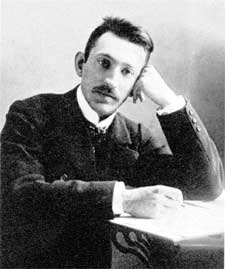
(3 May 1873 – 26 June 1945)
A Russian composer, pianist, and conductor. He was born in Saint Petersburg and studied under Nikolai Rimsky-Korsakov at the Saint Petersburg Conservatory. In 1918, he was invited to take the post of director of the National Conservatory of Tbilisi, the capital of the Democratic Republic of Georgia.
Following the Bolshevik takeover of Georgia in 1921, he moved to Paris and lived there for the rest of his life. While in France, he worked with Anna Pavlova and her ballet troupe as composer and conductor (1922–4) and made concert tours around Europe and the United States, but abandoned his concert career in 1933 because of a deterioration in his hearing.
In 1925, he founded the Russian Conservatory in Paris and served as its director for a number of years (1925–9 and 1938–45). In 1926, he became a member of the board of trustees of the Belyayev publishing house, where he later became president from 1937 until his death in 1945.
Giorgi Kvinitadze

(21 August 1874 – 7 August 1970)
A Georgian military commander who rose from an officer in the Imperial Russian army to commander-in-chief of the Democratic Republic of Georgia. He helped establish a military school in Tiflis and served as its Commandant before being made Commander-in-Chief of the Georgian army again early in May 1920, when the Bolsheviks attempted a coup d’état.
He happened still to be on the spot when the Bolsheviks assaulted the military school as a preliminary to a coup. Kvinitadze, with his cadets, put up a stout resistance and successfully defended the building. Days later, at the head of the Georgian army, he rolled back an attempt by the Soviet Russian troops to penetrate from Azerbaijan.
After the Sovietization of Georgia, Kvinitadze went into exile to France, where he wrote his memoirs of the 1917–1921 events in Georgia.
Click here for more information.
Sasha Gegechkori

( 23 November 1887 – 7 June 1928)
Soviet statesman and party activist, member of the revolutionary movement in the Caucasus. He lived in the house of the Bozarjants after the house was nationalised. In 1928, he committed suicide.