Table of Contents
Kapustnik
Kapustnik could be translated as “cabbage festival” or “cabbage party”. It is the Russian tradition of celebration. Generally, it is a medley of well-known songs, in which all the lyrics have been changed to celebrate (or poke fun at) the guests of honour.
Click here for more information on Kapustnik.
Elsa Triolet
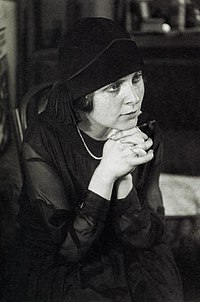
Elsa Triolet (24 September [O.S. 12 September] 1896 – 16 June 1970), born Ella Yurievna Kagan in Moscow, was a Russian-French writer. For my quotation, see: Dr. Maria Rubens, Russian Montparnasse: Transnational Writing in Interwar Paris, Palgrave Macmillan, 2015. For more about Triolet: click here.
Jean Guyon-Cesbron

Jean Guyon-Cesbron Born in Marines (Seine-et-Oise) in 1902, studied at the colleges of Grand-Champ, in Versailles; Sainte-Croix, in Neuilly; Mongazon, in Angers. At fifteen, he suffered from polio, which permanently deprived him of the use of his legs. In 1926, he began to write his first novels, and then he moved to Paris with a disabled bike, which allowed him to move around as he pleased. In Montparnasse, he contributed as a critic or reporter to numerous newspapers, weeklies and magazines. Date of death unknown.
Velocimane

In a corner the French novelist Jean Guyon-Cesbron was sitting, a black hat pulled deep over his square face, a cigarette dangling between his lips. Polio had permanently deprived him of the use of his legs, but a mutilated ‘velocimane’ – a tricycle for invalids – allowed him to circulate as he pleased.
Prologue
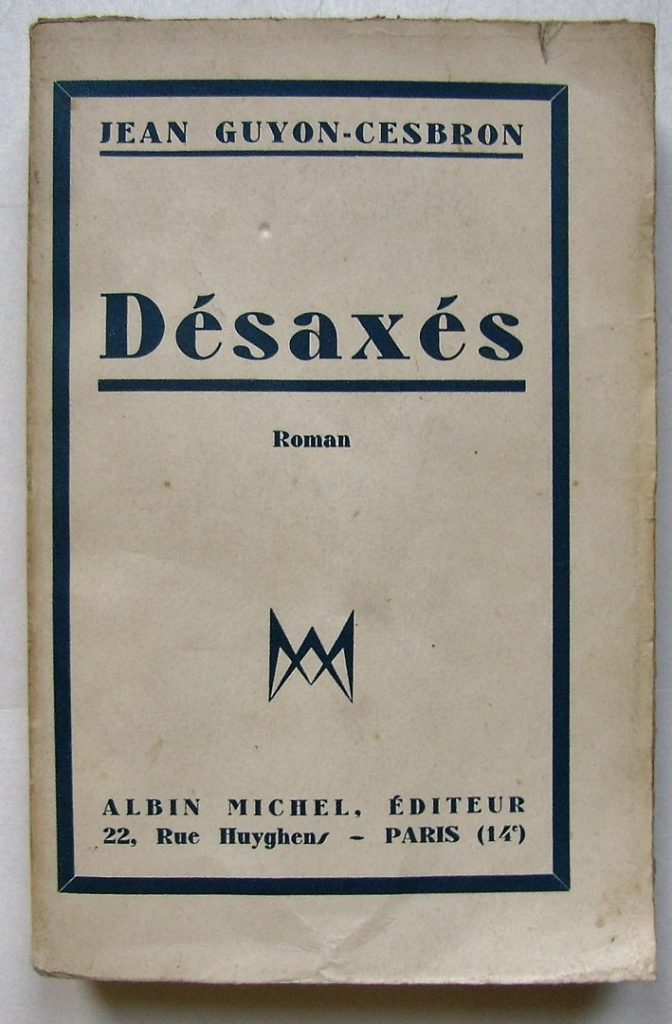
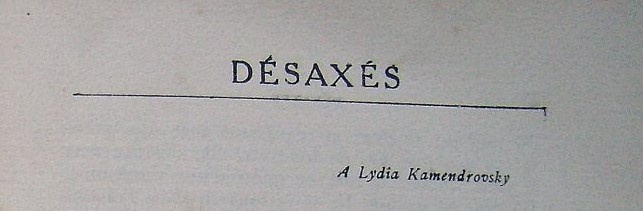
Jean Guyon-Cesbron’s book dedicated to Lydia
Before Lydia could leave again, Jean gave her the folded paper flower he had made. “For you, the Rose of Russia,” he said. Her cheeks flushed as she covered her ears with her wavy chestnut hair (she did that a lot when feeling insecure)and gave him a shy little smile. She must be his age. She was the only one who didn’t make him feel like an invalid; that was one of the things he liked about her. “My next book,” he said, “I will dedicate to you.” And with amusement he watched her flush deepen. He smiled. Life was good.
Prologue

Balalaika
A Russian stringed musical instrument with a triangular wooden, hollow body, fretted neck and three strings.